
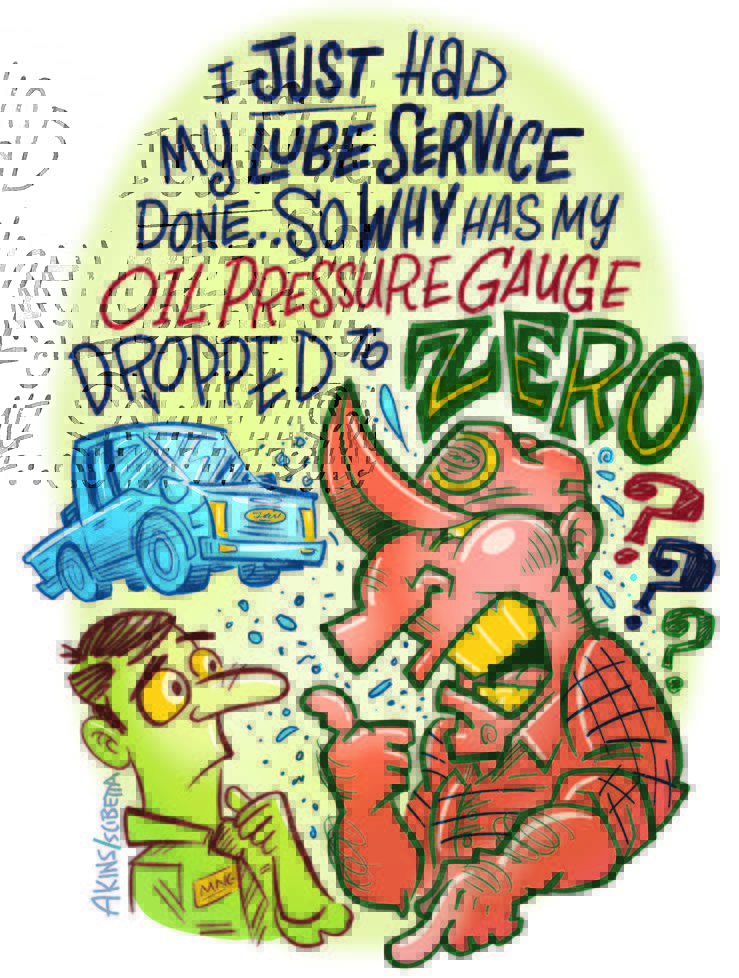
Nothing gets the vehicle owner’s attention any faster than a “Low Oil Pressure” warning. For the lube shop owner, the worst possible time for a symptom like this to occur is following a lube service. Trying to convince the vehicle owner the symptoms were not related to your service can be a challenge.
The Ford F150 4×4 equipped with the 3.5L EcoBoost displayed a “Low Oil Pressure” warning message and the oil pressure gauge dropped to zero. Those symptoms will cause any vehicle owner or seasoned technician to panic.
Failure Symptoms
The Low Oil Pressure warning would appear in the instrument cluster, and the oil pressure gauge needle would drop to zero when the idle speed approached 500 RPMs. Much later in the diagnostics, it was determined a slight increase in the idle RPM would extinguish the warning message, and the oil pressure gauge would display a normal oil pressure reading. And this is where opinions differ on the cause and cure for the symptoms, as there are several possibilities that must be considered when troubleshooting a low or no oil pressure symptom.
Let’s consider some possibilities:
Oil Pressure Switch
Chances are great the symptoms can be corrected by installing a new oil pressure switch. If the application is a 4×4, you will need a mirror and a flashlight just to inspect the switch and connector, as it is located behind the alternator and beneath the plumbing for the driver side turbo-charger. The oil pressure sensor is an on/off switch with no reflection of the actual engine oil pressure. The engine has pressure, or it doesn’t. Replacing the switch on a 4×4 must be done from beneath the hood. If the vehicle is a 2-wheel drive, accessibility to the sensor can be achieved from beneath the vehicle. The switch is positioned directly behind the alternator, so be certain to disconnect the negative battery cable before attempting to replace it. Damage to the alternator can be expensive and labor-intensive, somewhere in the range of $1,000 in parts and labor.
I just changed an oil pressure switch for the symptoms illustrated in this writing. The application was a 2013 F150 4×4, and by the time I completed the job, I looked like I had been in a hatchet fight. I had lots of cuts, bruises, and scrapes, but I was successful in restoring the gauge reading and eliminating the warning lamp.
Increasing Idle RPM
We have had reports of technicians restoring the gauge readings and extinguishing the Low Oil Pressure warning message by performing a throttle-body clean-up, which often increases the idle RPM. Others have accomplished the same via a program modification in the PCM to increase the idle RPM. Both may work, but it wouldn’t be my first choice of repair.
View PDF
Leave a Reply