
The oil filter often gets the blame for oil leakage concerns, especially if the vehicle has recently had a lube service. Oil filters and gaskets are often replaced in a futile attempt to eliminate the leakage, and the vehicle owner usually returns with the same complaint. Taking the time to make an accurate diagnosis can save the technician and the customer much frustration. If there is evidence of leakage prior to performing the lube service, make the customer aware and document the condition on the repair order. Following are some examples of oil leakage sources that are often mistakenly blamed on the oil filter.
Kia Extends Warranty
Kia provides a warranty extension program for oil leakage complaints involving the oil filter housing gasket on certain 2020-2025 MY Telluride (ON) vehicles produced from January 9, 2019 through June 12, 2025. The extended warranty coverage for the leakage symptom is for 15 years/180,000 miles, whichever occurs first. Subject vehicles may develop an oil leak from the oil filter housing gasket that seals the housing to the engine (see illustration 1). If the leakage from the housing gasket is confirmed, it should be replaced at no cost to the customer.
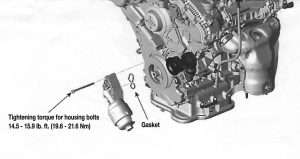
Illustration 1
While there is no mention of a recall or special warranty coverage, numerous Kia and Hyundai applications equipped with V-6 engines are fitted with the same style oil filter housing and gasket arrangement. These vehicles are susceptible to the same leakage concerns. Any warranty on these applications has long expired. And to be fair, it is a gasket with a life expectancy.
Perform a close inspection of the filter housing looking for any evidence of a damaged, warped or cracked housing. Damage to the housing may result from overtightening the oil filter cap. The failure rate for the plastic housing is high enough to warrant an aftermarket replacement housing upgrade to an aluminum version.
Chrysler’s 3.6L Pentastar Engine
Oil filter housing and cooler leakage have plagued Chrysler’s 3.6L Pentastar engine. The same housing arrangement is found on applications from 2011-2027. The assembly is positioned beneath the intake manifold in what is considered the valley of the engine block (see illustration 2).
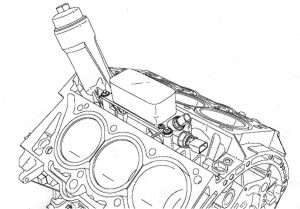
Illustration 2
When leakage occurs, a quart of oil may accumulate in the valley before displaying any evidence of leakage. A wooden stick serving as a dipstick can provide evidence of leakage when inserted next to the oil filter housing and allowed to bottom out in the engine valley. The presence of oil pooling in this area should be addressed immediately, as there have been reports of engine fires.
Overtightening the oil filter cap can damage the housing in the form of cracks or disturbing the O-rings, resulting in oil or coolant leakage. The torque spec for the cap is 25 Nm (18 ft. lbs.). In addition, removing the cap often requires excessive force, as the plastic cap tends to seize on the filter housing.
Mopar Cooler Leakage
Many vehicles are equipped with an oil cooler, which is often the source of oil leakage instead of the oil filter. Pinpointing the source of leakage starts with a thorough clean-up. Once completed, run the engine while observing the oil filter and cooler, especially the area behind the oil cooler. The source of the leakage is often from the gasket that seals the cooler to the engine (see illustration 3).
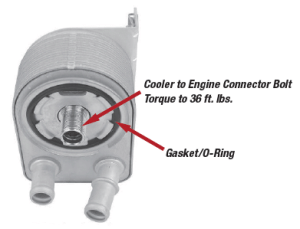
Illustration 3
Some coolers have a history of failure such as Chrysler, Dodge and Jeep applications equipped with the 2.0L and 2.4L engines. There are two areas of concern when diagnosing oil leakage concerns with the cooler:
Leave a Reply